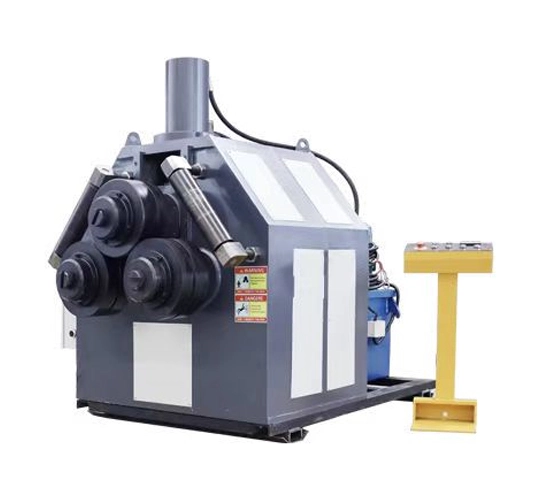
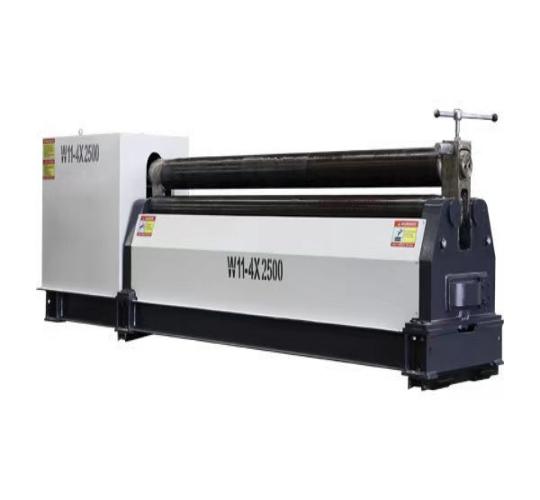
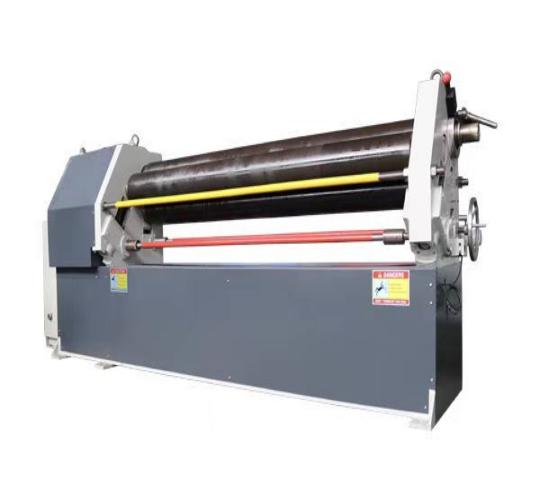
The key 3 roll bending machine specifications to evaluate are maximum rolling thickness, maximum plate width, pre-bending capability, minimum rolling diameter, and roller dimensions. For an asymmetrical 3 roller bending machine, the offset arrangement of the rollers allows the plate to be clamped and pre-bent effectively before the main rolling operation, making the configuration suitable for cylindrical and curved workpieces where controlled forming is required.
Capacity should not be judged from plate thickness alone. The material grade, yield strength, plate width, required diameter, and bending sequence all influence the practical working range of a machine.
What Specifications Determine the Capacity of a 3-Roll Plate Rolling Machine?
The primary capacity parameters are maximum plate thickness and maximum plate width. However, these figures describe a defined operating condition rather than every possible combination of thickness and width.
For a 3 roll plate rolling machine, manufacturers typically establish capacity according to material strength and a specified minimum rolling diameter. A machine may handle its maximum rated thickness at a larger diameter but require a lower thickness when forming a much smaller cylinder.
Roller diameter and center distance are also important. Larger rollers can provide greater forming capability and rigidity, while the working length determines the maximum usable plate width.
When comparing models, buyers should therefore examine thickness, width, material strength, and minimum diameter together rather than selecting a machine from one capacity number.
How Does Pre-Bending Work on an Asymmetrical 3-Roller Bending Machine?
Pre-bending prepares the plate ends before the main rolling process. On an asymmetrical 3 roller bending machine, the plate can be positioned between the rollers so that one end is brought into close contact with the appropriate roller while pressure is applied.
This reduces the amount of flat material left at the beginning and end of the finished cylinder. The exact procedure depends on the machine structure and roller arrangement, but the objective remains the same: establish the required curvature at the plate ends before completing the cylindrical form.
Effective pre-bending is particularly important when the finished component must connect accurately to another section or when minimizing straight-end allowance is a production priority.
What Is the Minimum Diameter of a Three Roll Plate Bending Machine?
Minimum rolling diameter refers to the smallest diameter that the machine can form under a specified material thickness and strength. It is not a universal value independent of operating conditions.
Plate thickness, material yield strength, roller diameter, roller spacing, and machine rigidity all affect the achievable diameter. As the required diameter decreases, the forming load generally increases, which can limit the thickness that can be processed safely.
For this reason, a machine's stated minimum diameter should always be considered together with the corresponding plate thickness and material grade.
Why Do Roller Dimensions Matter in 3 Roll Bending Machine Specifications?
Roller diameter and working length directly influence both forming capability and machine stability. The upper roller provides the main forming surface, while the lower and side rollers determine how the plate is supported and positioned during bending.
A longer working width provides greater capacity for wide plates, but it also requires sufficient structural rigidity to maintain forming accuracy across the entire width.
For buyers comparing 3 roll bending machine specifications, roller dimensions should therefore be reviewed alongside rated capacity rather than treated as secondary specifications.
Can a 3-Roll Plate Rolling Machine Bend Different Materials?
Yes, but the achievable thickness and diameter depend on material properties. Carbon steel, stainless steel, aluminum, and other alloys have different yield strengths and forming characteristics.
A machine rated for a particular thickness of mild steel may not provide the same capacity when processing higher-strength stainless steel. The required bending force increases as material strength rises, which can reduce the practical capacity at the same plate width and diameter.
Material grade should therefore be specified when requesting a machine quotation or technical recommendation.
How Should Buyers Compare Asymmetrical 3-Roller Bending Machine Specifications?
A useful comparison should cover the complete forming envelope rather than a single headline capacity. Important parameters include maximum plate width, maximum thickness, minimum rolling diameter, pre-bending thickness, roller diameters, roller center distance, motor power, and machine dimensions.
It is also useful to distinguish between maximum rolling thickness and maximum pre-bending thickness. These values may differ because pre-bending places different loads on the machine and requires a specific roller position.
For production planning, buyers should provide the supplier with the material, thickness range, width, target diameter, and expected production volume. This allows the machine configuration to be evaluated against actual forming requirements.
What Is the Difference Between Rolling Thickness and Pre-Bending Thickness?
Rolling thickness describes the plate thickness that can be formed into the specified diameter under defined conditions. Pre-bending thickness refers to the maximum plate thickness that can be effectively bent at the plate ends before rolling.
The two specifications should not automatically be assumed to be identical. A machine may have a greater rated capacity for rolling than for pre-bending, particularly when the required end curvature is demanding.
Checking both specifications helps prevent a common purchasing mistake: selecting equipment based on maximum rolling capacity while overlooking the end-bending requirements of the finished component.
Conclusion
The performance of a three roll plate bending machine depends on how its capacity, pre-bending capability, and minimum diameter work together. Maximum thickness alone does not provide enough information to determine whether a machine is suitable for a particular fabrication process.
When evaluating an asymmetrical 3 roller bending machine, buyers should compare plate width, material strength, rolling thickness, pre-bending thickness, roller dimensions, and minimum diameter under clearly defined operating conditions. This approach provides a more realistic basis for selecting equipment and avoiding capacity mismatches in production.
FAQs
What are the main 3 roll bending machine specifications?
Maximum thickness, plate width, minimum rolling diameter, pre-bending capacity, roller dimensions, and motor power are key specifications.
What does minimum rolling diameter mean?
It is the smallest diameter a machine can form under specified material, thickness, and operating conditions.
Why is pre-bending important?
Pre-bending reduces the unformed straight section at the plate ends and helps achieve a more complete cylindrical shape.
Can the same machine bend different plate materials?
Yes, but capacity changes with material strength, thickness, width, and required diameter.
Is maximum thickness the most important specification?
No. Maximum thickness must be evaluated together with plate width, material strength, minimum diameter, and pre-bending capability.
 English
 日本語
日本語 한국어
한국어 français
 Deutsch
 Español
 русский
 Türkçe
 português
 العربية
 Polska
 हिंदी
हिंदी Indonesia